Brain sells cyber and AI security awareness solutions, fully online. With your consent, measurement cookies show us the pages and products you visit: only to understand your needs, improve the site and give you better advice. If you arrive from one of our Google or LinkedIn ads, measurement tells us which one brought you here. No data resale, no targeted advertising on this site.
You help us give you better advice
The site works exactly the same
What we actually do
If you accept: we measure your journey on the site (pages viewed, products opened, path taken), via our in-house tool, Google Analytics, LinkedIn and HubSpot, to understand what you are looking for and answer you better.
What we never do: sell your data, retarget or profile you for advertising. Note: if you are signed in to LinkedIn, LinkedIn recognizes your account during measurement.
Either way: your choice, the language and the sound setting stay in your browser (local storage, never transmitted).
If you book a time: scheduling opens at HubSpot, which manages its own cookies on its page.
The phishing simulator that trains your teams on real attacks, from the fake email to the booby-trapped QR code, in a controlled setting that never captures a password.
A ready-to-use catalog
Over 1,300 scenarios sorted into around twenty pretext families, filtered by your company profile.
Today’s attacks
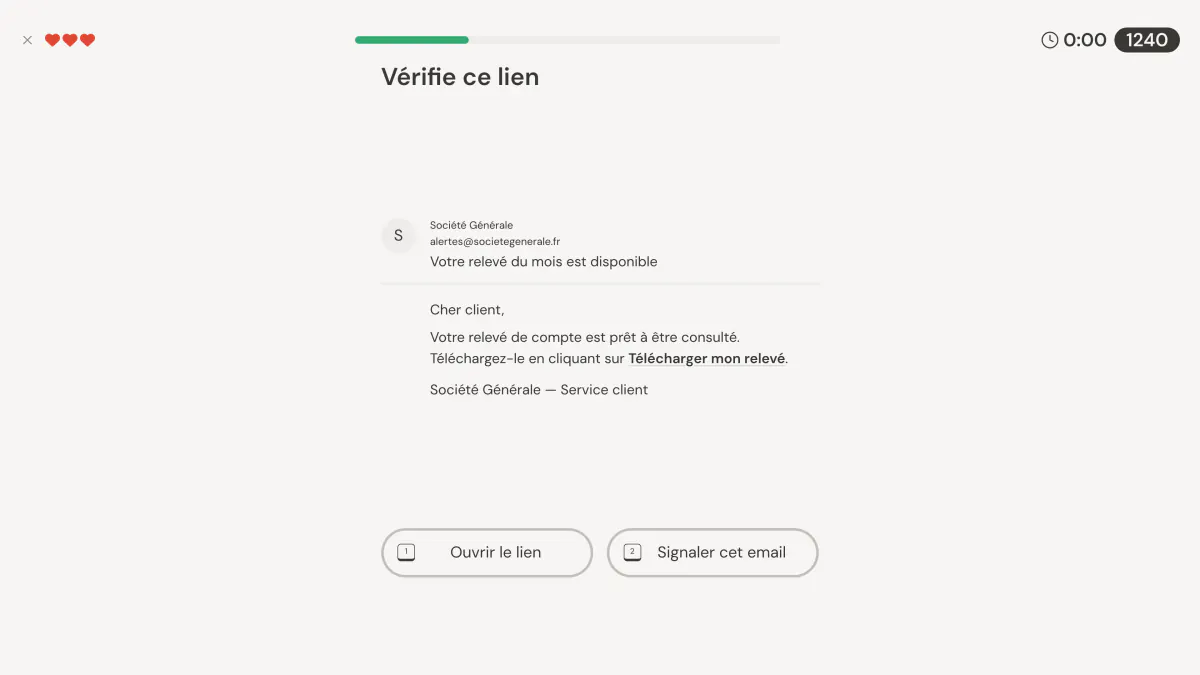
The fake email, but also the booby-trapped QR code, the fraudulent attachment and the fake verification page.
A controlled setting
Signed mandate, verified domain, test send to yourself, and never any password captured.
The debrief that matters
Who clicked, who reported, reporting rate: the measure that moves your teams forward.
The fully customizable cyber competition: custom game flow, boss fights and a public leaderboard.
Through a simple link (or QR code). They pick a nickname and play, no account creation, and in arcade mode, even the nickname becomes optional.
The game flow (which formats, how many questions, where the bosses go), the number of lives, the run duration, the scoring mode, and even your own question bank through Content Studio.
Yes: the skills map shows where each team is progressing, theme by theme, with export. SAML SSO connects your company directory.
The security awareness arcade cabinet. Configured online, delivered turnkey.
No. The cabinet runs on its own: attract mode, free-play game, and a leaderboard that keeps the competition going.
In the online 3D configurator: pick a preset or compose your faces (text, logo, images), share your configuration with a link (with a designer if needed), then order.
The 4G router + SIM option (1 year included) makes the cabinet fully independent from the site’s network.
Volume discounts apply: 10% off from 3 to 9 cabinets, 20% off from 10 cabinets. Get in touch and we’ll put together a tailored quote.
The fully configurable reflex competition: timed mini-games, cyber, AI or mixed universes, arcade mode.
Cyber Cup is a knowledge arcade quiz; Super Challenge tests reflexes against the clock, with lives. Both share the same engine and launch from a link.
Spotting generated content, catching a deepfake, judging a prompt, checking a source: the everyday AI reflexes. The mixed universe combines cyber and AI.
Yes: depending on the setting (1, 3 or 5 lives), every mistake costs one. That’s what keeps the competition tense.
The deepfake photobooth: allow your webcam, watch an AI transform you live, and never look at an image the same way again.
No. The feed is processed in real time and nothing is recorded or kept. Captures carry an “AI-generated” watermark.
No: open the link, allow your webcam, see yourself transformed. The session is deliberately short.
To make people live the deepfake instead of explaining it: once you have watched your own face lie on screen, you never look at a video call the same way.
The phishing simulator that trains your teams on real attacks, from the fake email to the booby-trapped QR code, in a controlled setting that never captures a password.
No: Super Phisher is an awareness tool. No password is captured, every campaign requires a signed mandate and a verified domain, and you can send the lure to yourself before any launch.
The fake email, but also the booby-trapped QR code, the fraudulent attachment and the fake verification page. Each recipient gets a scenario matched to their language.
The debrief shows who clicked and above all who reported the attack, with your teams’ reporting rate, campaign by campaign.
The narrative game that teaches cybersecurity through play: ten chapters, a level map, with nothing to install.
No: the game plays directly in the browser, with nothing to install and no account to create. An email is enough to get started.
Ten chapters, from how the brain handles risk to malware, by way of passwords, the man-in-the-middle, social engineering and phishing.
Yes, in French and English, chosen right when you enter the game.
Compare
Annual e-learning, phishing simulation, one-off workshops, games: four ways to raise awareness in your teams, what each one brings and what Brain adds.
Criterion
Annual e-learning
Phishing simulation
One-off workshop
Brain
Format
An online module to complete, often once a year, hosted on the LMS.
Simulated phishing emails sent to inboxes, with a training page for those who click.
A workshop, a talk or an escape game, in person or remote.
A collection of small tools: competitions, mini-games, messaging bot, learning path, encyclopedia, arcade kiosks.
What the employee experiences
They go through the module to the end and pass a quiz.
They receive a simulated phishing email and practice spotting and reporting it; if they click, they see a short reminder right away.
They take part in a group session led by a speaker.
They play for one minute or five, compare themselves with colleagues on a leaderboard and come back.
A quote, a date, a room or a video call, a speaker.
A free self-service account, a link or a QR code to share. Zero install.
Rhythm
One campaign a year, sometimes quarterly.
Waves of emails through the year.
One or two highlights a year.
Highlights (cybersecurity awareness month, AI Spring, trade show) and a year-round thread, in small doses.
What you measure
Completion rate and quiz scores.
Click rate and reporting rate.
Attendance and on-the-spot satisfaction.
Participation, progress and completion, with exports provided by default.
Topics
The chosen catalog program, mostly cyber.
Phishing and its variants.
The topic of the session.
Cyber and AI, enabled separately.
Employee data
A named account per learner.
Email addresses and each campaign’s results (clicks, reports), by name or aggregated depending on settings.
An attendance sheet.
In competitions and on kiosks, no player account: a nickname and a score.
Pricing model
Most often a license per user per year.
Most often a license per user per year as well.
A quote per session.
Public prices: free to test, credit packs paid per participation, unlimited annual plan on quote.
On site
Rarely: the module is taken online, on a computer or phone.
Not usually: it happens in the inbox, sometimes via text message or QR code.
Yes, that is its home ground.
Yes: a real arcade kiosk in the lobby, on top of online play.
A complement, not a replacement
Brain replaces neither the mandatory module nor your phishing simulations: it adds what they are not designed to do (highlights, competition, on-site presence) and gives you the record of a living program.
Each Brain tool can be used on its own. The Brain Platform brings them together in a single cybersecurity and AI awareness program: the program owner sets a goal, each employee takes part in the format that suits them, and a training record keeps track of participation. It is not self-service: there is no account to create online; we set it up with you after a conversation with our team.
No. The mandatory module remains useful for compliance. Brain comes on top: highlights, competition and on-site presence to create engagement, with participation, progress and completion exports to keep the record.
Yes. Products open for signup can be tried in self-service, with a free account and no credit card, and prices are public. Some products are already deployed with customers and are available by appointment: we set them up with you after a conversation with our team. A call is also needed for the Brain Platform, a kiosk, an unlimited subscription or a specific need.
Gamified cybersecurity awareness platforms: how to choose
A gamified awareness platform turns cyber reflexes into a game: points, rankings, timed challenges, sometimes an arcade cabinet. To choose, compare what keeps people coming back (teams, rankings, short formats), access from a phone, languages, public prices and whether you can try it alone before buying. Brain Security brings these formats together, from the online quiz to the cabinet on site.
Updated November 3, 2026
What gamified awareness is
It is a program where people learn by playing instead of sitting through one more module: they answer timed questions, face another team and try to beat their own score. The game does not replace the mandatory compliance module. It brings employees back and keeps reflexes sharp between the big moments.
Game formats, and when to choose them
Format
When to choose it
In Brain
Quiz and competition between teams
To get many people playing fast, from a phone, with a live ranking.
Cyber Cup and Super Challenge, with a free account
Short game in the browser
For a fun break or a workshop: a few minutes, no account to create.
Super CISO Destroyer and Deepfake Studio, free to play, no account
Arcade cabinet
For a lobby, a booth or a trade show: people stop, play and check the ranking.
Brain Arcade: large 181 cm cabinet or bartop
Bot in the messaging app
To keep reflexes sharp all year, in small doses, where teams already work.
Chat with Jack, in Slack and Microsoft Teams (Google Chat coming soon), by appointment
Phishing simulation
To train people on fake emails and trapped QR codes in a controlled setting.
Super Phisher, by appointment
The criteria for choosing
Ask every platform the same questions. Who plays, and why will they come back? Can people play in teams, with a ranking? Does everything work on a phone, with nothing to install? In which languages? Are prices public, or do you have to go through a salesperson? Can you try it alone, without a credit card? Do you keep a record, with participation and progress exports to show management?
Where Brain Security fits
Brain Security designs awareness games for cybersecurity and AI. Cyber Cup and Super Challenge can be tried with a free account, no credit card, and their prices are public on the Pricing page. Some products, already deployed with customers, are set up by appointment. The Brain Platform brings these tools together in a single program; it is not self-service, and we set it up with you after a conversation with our team.
No. The mandatory module stays useful for compliance. The game complements it: it brings teams back, creates friendly rivalry with a ranking and provides participation, progress and completion exports to keep a record.
Quizzes and team competitions, short browser games, arcade cabinets, bots in the messaging app and phishing simulations. Brain Security offers each of these formats; the table above says which one to pick for which occasion.
Yes. With Brain Security, a free account, no credit card, opens the admin console and gives you five first test accesses on Cyber Cup and Super Challenge. Super CISO Destroyer and Deepfake Studio are free to play, no account needed.
You create the competition, the questions are already there, you share a single link: your teams are playing within the minute. Everyone plays from a phone or a computer, with nothing to install and no player account to create.
Arcade cabinet and cybersecurity tournament for your events
To liven up a cyber event, install an arcade cabinet that welcomes people on site and run an online tournament alongside it for everyone else: the two work together. Brain Security builds and installs the Brain Arcade cabinet (large 181 cm cabinet or bartop) and provides the Cyber Cup quiz-arcade for the tournament. A ranking shows live, and exports feed the debrief.
Updated November 3, 2026
For which events
Cyber month, a trade show, a seminar or a convention, a security day, or a site lobby all year round. The principle is always the same: a short game, played standing up in a few minutes. On the cabinet, a nickname kiosk replaces any form, so no personal data is collected on players.
Which format for which occasion
Occasion
Recommended format
What Brain brings
Cyber month
An online tournament all month long, with a cabinet in the lobby if you like.
Cyber Cup or Super Challenge, a live ranking, exports for the debrief; the Cyber Month page details the program
Trade show or booth
One or more cabinets for a few days.
Brain Arcade for the length of the event, on quote
Seminar or convention
A tournament between teams, on phones, with a ranking displayed live.
Cyber Cup: one link to share, nothing to install
Security day or site lobby
A cabinet installed in the lobby, staying all year.
Brain Arcade on an annual license per cabinet, public prices on the Pricing page
Teams across several sites
An online tournament each site plays on its own, with a local cabinet as an option.
Cyber Cup, playable from any phone
The Brain Arcade cabinet
You configure the cabinet in 3D, from 12 designs, in your colors. Brain builds it, delivers it and installs it in mainland France; it remains Brain’s property and you pay for its use through an annual license. Two sizes exist: the large 181 cm cabinet and the bartop, a compact cabinet. Participants and games are unlimited, with no credits used.
The online tournament
Cyber Cup is a competitive quiz-arcade: you share a link, everyone plays from a phone with no account to create, and the ranking shows live. The questions are already there, you build the running order and switch on boss fights between rounds. Super Challenge adds timed reflex challenges, on cyber, on AI or on both.
The cabinet is offered on an annual license, per cabinet: Brain builds it, delivers it and installs it, and you pay for its use, not its purchase. Year 1 and following-year prices are public on the Pricing page, with a discount from 3 cabinets. For a few days at a trade show or seminar, pricing is on quote.
Yes. The online tournament runs on its own: a link to share, a phone or a computer, nothing to install. The cabinet is an option to make an impression on site.
No. On the cabinet, a nickname kiosk replaces any form: no personal data on players. Online, players have no account to create.
Book an appointment: together we settle the number of cabinets, the duration, the venue and the logistics, then you receive a quote. The service is paid in advance, which guarantees the booking of the slots.
Cybersecurity serious game: online games, cabinet or escape room
A cybersecurity serious game is a game designed to build reflexes: spotting a fake email, choosing a password, catching a deepfake. Brain Security offers serious games online, in the browser and on an arcade cabinet. Brain does not offer physical escape rooms: no room to book, just games you launch with a link.
Updated November 3, 2026
Brain does not run a physical escape room
Brain Security does not offer physical escape rooms: no room, no game master, no on-site scenario. Instead, its games are launched online or on an arcade cabinet, and played alone, in teams or for a ranking. For a big moment on site, we install a cabinet and launch a tournament: the activity needs no room and no scenario, and you keep a ranking and participation figures.
Brain’s serious games, format by format
Format
Principle
At Brain
Online quiz-arcade
Timed questions, boss fights between rounds, live ranking; played on a phone.
Cyber Cup, with a free account
Reflex challenges
Timed mini-games on cyber, on AI or on both.
Super Challenge, with a free account
Games in the browser
A two-minute 3D round to let off steam, an AI photo booth that shows a deepfake live, or a ten-chapter narrative game.
Super CISO Destroyer and Deepfake Studio, free and no account; Cybersecurity is not a game, by appointment
Arcade cabinet
The same quiz-arcade in a real cabinet, for a lobby or an event.
Brain Arcade: large 181 cm cabinet or bartop
Physical escape room
A room, a team, puzzles, in person.
Not offered by Brain
Serious game, escape room, competition: the differences
A serious game teaches through play: the game is the vehicle, and the content is about a real cyber topic. An escape room is a room-based format, in person, in a group, often for an hour, with puzzles. A competition adds a ranking: you play to beat a score. The same game can be both a serious game and a competition.
When to choose what
To reach many people fast, an online quiz. To keep reflexes sharp over the year, short challenges. For an event on site, a cabinet and a tournament. For an audience discovering the topic, a game in the browser, no account. For a room and an hour of puzzles, an escape room provider: Brain is not one.
No. Brain does not offer physical escape rooms. It offers serious games online, in the browser and on an arcade cabinet: Cyber Cup, Super Challenge, Super CISO Destroyer, Deepfake Studio, the Brain Arcade cabinet and the narrative game Cybersecurity is not a game.
A quiz asks questions. A serious game adds a game on top: mechanics, a score, levels or boss fights. Cyber Cup is a quiz-arcade: questions, presented like an arcade game.
Yes. Super CISO Destroyer and Deepfake Studio are free to play, no account needed. Cyber Cup and Super Challenge can be tried with a free account, no credit card.
Yes: these games are for employees, not experts. A round usually takes a few minutes, with no prior training, from a phone or a computer.
How do you measure the effectiveness of a cybersecurity awareness program?
Track participation first, then quiz score progress, then behavior: click rate and reporting rate in phishing simulations, time to report, incidents declared. No single metric is enough on its own: cross-check them at regular intervals and compare with the previous period. Brain Security provides participation, progress and completion by default, with exports.
Updated November 3, 2026
Why participation comes first
A program nobody follows changes no reflex. If only the most motivated people play, your scores and rates describe the converted, not the company. So measure first the share of your teams that takes part, before asking what they learned. The other metrics only mean something for an audience that actually played.
Useful metrics, with their limits
Metric
What it measures
Its limit
Participation and completion
Who plays, and who sees the course through.
Says people showed up, not that they understood. Read it before anything else.
Quiz score progress
What people know, theme by theme, and how it changes from one key moment to the next.
A quiz measures knowledge, not behavior. A score can rise simply because the questions repeat.
Click rate and reporting rate in phishing simulations
The reflex facing a fake email: who clicks, who reports.
Depends on how hard the scenario is. Compare campaigns of the same level and look at reporting as much as clicking.
Time to report
How fast a suspicious message reaches the security team.
Needs reliable timestamps and enough reports for the average to mean something.
Incidents declared
The number of incidents employees raise on their own.
A rise can be a good sign, because people declare more. The causes are many: read it with care.
How often to measure
Participation is tracked continuously during a key moment, with a review at the end. Scores are compared from one key moment to the next. A phishing simulation is read campaign after campaign, with scenarios of the same difficulty. Incidents can only be judged over a year, because they are too rare for a shorter reading. Set the dates before you start and keep the same metrics from one period to the next.
How Brain helps, product by product
Cyber Cup and Super Challenge give participation, ranking and progress theme by theme, with a skills map and CSV or XLSX exports; you can try them with a free account. Super Phisher, by appointment, shows who clicked and who reported, with the reporting rate, campaign by campaign. Chat with Jack, in Slack and Microsoft Teams (Google Chat coming soon), by appointment, offers a dashboard of progress, quizzes and reports. The Brain Platform brings them together in a single program, with a training record; it is not self-service, and it is set up after a conversation with our team. Time to report and incidents declared come from your own tools: email, support, security team.
Participation: the share of your teams that really plays and finishes. Without it, scores and click rates only describe the most motivated people. Cyber Cup and Super Challenge give participation, progress and completion exports.
No. A low click rate can come from an easy scenario or a campaign few people saw. Look at the reporting rate too: someone who reports protects others, someone who does not click does not always raise the alarm. Super Phisher shows both, campaign by campaign.
Article 4 of the AI Act asks companies to take measures to develop the AI literacy of their staff. What matters is showing the actions taken: participation, progress by theme and exports. A Super Challenge in the AI universe, tried with a free account, leaves that trace.
On the cabinet, no personal data is collected on players. Online, there is no player account: only a nickname and a score. You then measure the participation and progress of the players.
How do you organize a cybersecurity tournament between a company’s departments?
Set a goal, form teams by department, plan two or three weeks of play, then launch an online tournament that everyone plays in a few minutes from a phone. With Brain Security, Cyber Cup provides the game, a link to share and a live ranking, individual and by nickname: Brain does not calculate a score per department. To compare departments, create one competition per department or ask everyone to put their department in their nickname; the final can be played on a Brain Arcade cabinet.
Updated November 3, 2026
A tournament, not one more module
The idea is to get people who rarely meet to play, with a simple stake: the pride of playing with colleagues. The goal stays participation, not the podium. To put numbers on the effect afterwards, the page on measuring the effectiveness of a program details the metrics. For an on-site event with an arcade cabinet, see the Cabinet and cyber tournament page.
The nine steps, and what Brain provides
Step
What to do
What Brain provides
Goal
Pick a single aim, for example getting as many people as possible to play, and announce it.
A conversation with our team to settle the games and the calendar
Teams by department
One captain per department. Ask players to put their department name in their nickname.
No account for players: a nickname is enough; one competition per department if you want separate rankings
Calendar
Two or three weeks of play, with a clear start date and end date.
Super Challenge switches on at a set date from the console; Cyber Cup is shared with a link
Themes and rules
Themes that speak to everyone, and rules in a few lines: duration, number of lives, rounds.
Cyber Cup: running order, lives, duration, scoring mode, your own question bank. Super Challenge: cyber, AI or mixed universe
Launch
Send the link or QR code with a message from management or the CISO.
A link or QR code to share; the questions are already there, your teams play within the minute
Live ranking
Show the ranking in the lobby, on the intranet or on a video call to keep the rivalry going.
An individual ranking, by nickname, that shows live; Brain does not calculate a score per department
Final, possibly on a cabinet
Bring together the top finishers of each department competition for a last round, on site.
Brain Arcade, large 181 cm cabinet or bartop, in arcade mode with no identity to enter; it remains Brain’s property, on an annual license at the public prices on the Pricing page, or quoted on request for a few days at a trade show
Prize-giving
Hand out the prizes in front of everyone and also recognize the most participative department.
The final ranking, to display during the prize-giving
Review
Share the figures with management and the teams, then announce the next edition.
Participation, ranking, progress by theme, CSV or XLSX exports to present to your executive committee
Three rules to bring everyone in
A short game: a round lasts a minute or five, not an hour. Rules that fit in a few lines, read by all. Visible results: a ranking people can see beats a reminder email. The ranking is individual, by nickname: to spotlight a department, compare its participation in the exports of a dedicated competition.
Keeping the momentum after the tournament
A tournament is a key moment. Between two key moments, small doses keep reflexes sharp: a short Super Challenge, or Chat with Jack in Slack and Microsoft Teams (Google Chat coming soon), by appointment. Plan the next edition as soon as the review is done, while people are still keen.
The game is ready right away: you create the competition, the questions are already there, you share a link. The preparation is mostly the goal, the teams and the dates. A conversation with our team is enough to settle the games and the calendar.
No. The online tournament runs on its own: a link, a phone or a computer, nothing to install. The cabinet is an option for the final or to make an impression in the lobby; the Cabinet and cyber tournament page gives the details.
Players have no account to create: a nickname is enough. The ranking is individual, by nickname, and Brain does not calculate a score per department. To compare departments you have two options: create one competition per department, each with its own ranking, then compare participation in the exports; or ask everyone to put their department in their nickname, for example FIN-Lynx or HR-Panda.
Figures, not an impression: participation, ranking, progress by theme, with CSV or XLSX exports. They show how many played and where players are improving.
Public prices, excluding VAT, with no quote needed for most of it: you choose a volume, you pay, you launch. Products open for signup are tried free first, with no credit card.
Getting started: free
A free account, no credit card, with the admin console, which uses no credits. Cyber Cup and Super Challenge include five free test accesses, the Brain Arcade configurator can be tried with the same account, and Super CISO Destroyer and Deepfake Studio are free to play, with no account. For the other products, each catalog page says how to get access.
Cyber Cup and Super Challenge: credit packs
One credit is one run for one participant. It is used at the participant’s first actual login: if they log in again or finish later, it is still one credit. A new run or a new edition uses a new credit.
Pack
Price excl. VAT
Discount
250 credits
450 €
baseline
500 credits
750 €
−17 %
1 000 credits
1 200 €
−33 %
2 000 credits
1 900 €
−47 %
5 000 credits
3 000 €
−67 %
10 000 credits
4 200 €
−77 %
Valid 12 months from purchase, usable on Cyber Cup and Super Challenge alike, with the balance shown in real time in the console.
No subscription, no renewal: when the credits run out, you decide whether to buy more.
Above 10,000 credits, pricing is on quote.
Unlimited annual subscription: on quote
Unlimited runs on Cyber Cup and Super Challenge, for the whole organization, all year round. The price is set in a meeting based on the number of users, the scope and the commitment length. 12-month firm term, tacit renewal, 2-month notice.
Brain Arcade: an annual license per cabinet
You design the cabinet in 3D, we build it, deliver it and install it. It remains Brain’s property: you pay for its use, not its purchase.
Model
Year 1 (excl. VAT)
Following years (excl. VAT, per year)
Full cabinet (about 181 cm)
7 000 €
3 500 €
Bartop (compact cabinet)
5 000 €
2 500 €
Year 1 covers design, custom graphics, manufacturing, delivery and installation in mainland France, the license and maintenance. The following years cover the license, content updates, hosting, support and maintenance.
Unlimited players and runs, with no credits used.
12-month minimum commitment per cabinet, tacit renewal for 12-month periods, cancellable up to 2 months before the term.
Volume discounts: 10% off from 3 to 9 cabinets, 20% from 10. On quote: custom artwork outside the templates, delivery outside mainland France, on-site facilitation.
Events: on quote
Trade show, seminar, cybersecurity awareness month: cabinets for a few days. The price depends on the number of cabinets, the duration, the venue and the logistics. The service is paid in advance, which secures your dates.
Yes, 12 months after purchase, with a reminder 30 days before. Unused credits are lost, which is the counterpart of volume discounts. If Brain fails its obligations or removes a main feature, they are refunded pro rata.
Yes: within 14 days of an online order, as long as no credit was used, no game was opened to participants and no cabinet manufacturing was started.
Credits are paid at order time. Subscriptions are invoiced in advance and payable within 30 days. An event service is paid before the event.
Yes, for an annual subscription, more than 10,000 credits, an event or a multi-entity rollout. The Brain Platform, which brings the tools together in a single awareness program, has no public price: it is not self-service, we set it up with you after a conversation with our team.
Not without Brain’s written agreement: credits belong to the entity that bought them.
Brain collects the cabinet within 30 days, unless you say before the term that you want to continue: nothing changes then, except the price, which moves to the following-years rate.
Level upyour teams on cyber & AI,without putting them to sleep.
Brain is not an annual training people sit through: it is a collection of small tools (mini-games, competitions, a bot, training paths, an encyclopedia) and highlight moments that punctuate the year. Put end to end, they form a platform for a lasting security culture.
How we work
Reflexes all year long, in small doses.
One tool does not change a culture. A collection of tools, played all year and managed in one place, does. And it shows on both sides: the people who play, and the people who run the program.
For employees
Experiences that stick
One minute or five, at a booth or in the messaging apps. People play, compare scores, play again, and the reflexes sink in.
Timed reflex mini-games, cyber or AI topics
Link-based competitions with public leaderboards
On-site arcade cabinets for your highlight events
Micro-lessons in Slack and Microsoft Teams (Google Chat coming later)
Zero installEverything runs in the browser, from a simple link
No accountOn the player side, a nickname is all it takes
For the security team
Everything managed in one place
You manage all the content from the console, and you pull the numbers without having to ask anyone.
Design, content, customization, localization: everything is editable
Measurement tools included by default, on every platform
Participation, progression and completion exports
Cyber and AI topics can be enabled separately
DORA · NIS2Supports your regulatory obligations
AI Act · Art. 4AI literacy measures mandatory since 2025
Everything that is open can be tried, right now.
01
You open an account
Every product open for signup is self-service: you create your account on the one that interests you, without going through us. For the others, the product page says how to get access.
02
You test, you launch
You try it on one team, then roll it out. Measurement tools come by default in every platform.
03
You want more, we talk
Unlimited, MSP, the Brain Platform, which brings the tools together in a single program, or a need entirely your own: that is the moment to tell us about your needs.
A company with specific needs? Open up every element, customize content and design to your brand, roll out across multiple entities. Tell us about your needs, we build it with you.
Start with the catalog: open products can be tried right away. And as soon as you want to go further, we take it from there with you.
Book a call
Tell us about your needs: we set up a time, or we get back to you.
The most direct
Tell us about your needs
A special request? An awareness program to build, a specific population, context we should factor in? Book a time: we talk it through live, and look together at what fits your need.
Your context: populations, industries, languages, deadlines
The formats that fit: arcade, competitions, training paths
Integrations: Slack, SAML SSO, CSV and Excel exports
30 minutes, no commitment, with a member of the team.
In writing
Rather we get back to you?
Leave us your details and a couple of lines about your need. We get back to you quickly.
By sending this form, you agree that your data will be used to get back to you. Privacy policy · Cookies
Cyber Month 2026The cybersecurity awareness month
Let’s organizeyour cyberawareness month
For cybersecurity awareness month, every company runs its own campaign. Run yours arcade-style: your teams play, the leaderboard updates live, everything gets measured. Start for free, no commitment.
An event ready to launch, played anywhere, with results you can report.
01
A turnkey event
Zero onboarding: you create the competition, the questions are already there, you share one link. Your teams are playing within the minute.
02
Online or on-site, with cabinets
Everyone plays from their phone, wherever they are. Or you install a real arcade cabinet in the lobby for the whole month. The two combine.
03
Results to report
At the end of the month, you show figures, not an impression: participation, leaderboard, progress by topic and exports to present to your leadership team. A record that supports your DORA and NIS2 obligations.
Optional
The Brain Arcade cabinet, on your premises
The same game in cabinet mode: a nickname-only kiosk, with no personal data, in a real arcade cabinet installed at your site for the whole month.
Give them a reason to play rather than one more module: a competition between teams, with a leaderboard that updates live. Everyone plays from their phone, with no account to create on the player side.
Change the format: short, timed arcade-quiz runs, reflex challenges, an arcade cabinet in the lobby. A live leaderboard creates the friendly rivalry that traditional training lacks.
Keep your content and your e-learning, and add a highlight people can play: a tournament during the month, with a final leaderboard. The game comes on top of your mandatory module; it does not replace it.
With figures, not an impression: participation, leaderboard, progress by topic, and exports to present to your leadership team. A record that supports your DORA and NIS2 obligations.
You create the competition, the questions are already there, you share one link: your teams are playing within the minute. For a full program, a 20-minute call is enough to line up the games, the calendar and the communication kit.
No. Everything is played online, from a phone or a computer. The arcade cabinet is an option to make a splash on-site.
Need a hand
We’ll organize your month with you
Would you rather we put together a turnkey program for you? Leave a work email, we’ll get back to you with a plan.
The fastest way
A 20-minute call
We look at your context together and set the month’s highlights.
Brain Security brings games, videos, cheat sheets and competitions together in one program. Each employee picks their format, and competitions launch on their own.
Cyber Cup and Super Challenge: free trial, no credit card
Everything in play
Phishing
Attack simulations in a controlled setting, to reveal which reflexes need work. In production, by appointment.
Deepfake
A game that teaches you to spot a deepfake. Free to play, no account needed.
Shadow AI
Challenges and lessons on using AI well at work, such as avoiding data leaks.
Competition
Arcade-style quiz competitions with a live leaderboard.
Gamification
Games, points and leaderboards: teams play instead of putting up with it.
Chatbot
Short lessons right inside Slack and Microsoft Teams.
Coming soon
MCP
An AI agent connected through MCP runs the Platform like the administrator.
Coming soon
MSSP
The partner firm follows several clients from a single space.
Cyber Cup and Super Challenge: free trial, no credit card
What you see today
Your teams click “next” without reading.
Your competitions never take off.
You run five tools with no overall view.
What Brain Security does
Each employee chooses their own content: a game, a video or a cheat sheet.
Games and questions that teach the right reflexes.
Competitions that launch on their own, with tracking for the CISO.
The products in play
Cyber Cup and Super Challenge: free trial, self-service, no credit card.
Super Phisher: in production, by appointment.
Chat with Jack: Slack and Microsoft Teams.
Super CISO Destroyer: the satirical game for overworked CISOs, free.Play it
The Brain Platform brings these tools together in one program. It does not open in self-service: we set it up with you after a conversation with our team.
Every spring, companies take stock of AI: what can be trusted to it, what must be checked, what is no longer taken at face value. Turn it into an arcade season: your teams play, the leaderboard updates live, everything is measured. You start for free, no commitment.
A season ready to launch, played anywhere, that leaves a record.
01
A turnkey AI competition
Create your Super Challenge in the AI universe: deepfakes, prompts, confidential data, sources. The mini-games are already there, you share a single link, your teams play within the minute.
02
AI reflexes all season long
Chat with Jack sends micro-lessons in Slack and Microsoft Teams (Google Chat coming later). Cyberpedia offers an AI-generated visual encyclopedia to explore at your own pace. The spring lasts, so does the awareness.
03
The AI Act, Article 4
Since 2025, the AI Act has asked companies to take measures that develop the AI literacy of their staff. A season of play contributes to that and leaves a record: participation, progress by topic, exports.
Optional
The Brain Arcade kiosk, in your premises
Super Challenge in kiosk mode: a nickname kiosk, no personal data, in a real arcade kiosk installed at your site for the whole season.
A season of artificial intelligence awareness in the company, modelled on cybersecurity awareness month: a highlight where every employee learns the right reflexes for deepfakes, prompts, confidential data and generated content. Each company picks its own dates in spring.
Three building blocks are enough: a Super Challenge competition in the AI universe launched with a single link, Chat with Jack micro-lessons in your messaging app for the whole season and, for a physical highlight, a Brain Arcade kiosk in the lobby. A free account lets you test everything before deciding.
A competition is created in a few minutes, with no onboarding or purchase order. Allow a 20-minute call with us if you want a turnkey program for the whole season.
Launch a Super Challenge in the AI universe and share it with a single link: your teams practice understanding AI, verifying answers, prompting well and spotting a deepfake. The skills map tracks their progress theme by theme, and the console exports the results as CSV or XLSX. These are all measures you can document under Article 4 of the AI Act, which asks companies to develop the AI literacy of their staff. You can try it first with a free account.
Need a hand
We organize your spring with you
Would you rather we suggest a turnkey program? Leave a business email and we come back with a plan.
The fastest
A 20-minute call
We look at your context together and set the season’s highlights.
Lagtavling i cybersakerhet: Metoden som nar over 80 procent deltagande
Upptack hur en intern lagtavling i cybersakerhet engagerar hela organisationen, bygger sakerhetskultur och overtraffar era utbildningsmal.
Publicerad · ⏱ 6 min
✓ Brain Security · FoU Cyber & Mänskliga Faktorn⚖ MSB · CERT-SE · Cybersäkerhetslagen (NIS 2) · DORA · IMY★ Super Challenge
Varje CISO och IT-sakerhetsansvarig har nagon gang sett samma dystra statistik i sin instrumentpanel: tre veckor efter att den obligatoriska digitala utbildningen om cybersakerhet skickades ut har knappt 22 procent genomfort den. Automatiska paminnelser sorteras snabbt bort som skrappost, avdelningschefer suckar over administrationen och IT-sakerheten uppfattas aterigen som ett hinder i vardagen. Nar medarbetarna drabbas av klicktradom och ensamma maste ta sig igenom tunga utbildningsmoduler har de traditionella, toppstyrda metoderna natt sin grans.
Det finns dock en beprovad psykologisk drivkraft som i grunden forandrar detta: lagandan och den kollektiva kamratskapen. Genom att byta ut individuella reprimander mot en engagerande lagutmaning ber ni inte langre medarbetaren att gora ett test for att slippa kritik. Ni ger dem chansen att hjalpa sin egen avdelning att vinna. Det ar just detta skifte mot en kollektiv utmaning som gor det mojligt att korsa den historiska gransen pa 80 procents faktiskt deltagande.
Hur organiserar man en framgangsrik tavling i cybersakerhet mellan avdelningar?#
Sammanfattning: For att genomfora en engagerande tavling i cybersakerhet delar ni in organisationen i naturliga team per avdelning, anvander korta och tydliga regelverk samt lanserar snabba quizronder. Genom att kombinera realtidsledartavlor med inkluderande amnen forvandlar ni ett regulatoriskt krav till en gemensam utmaning for alla roller, helt utan tekniska hinder.
Nar ni planerar en intern utbildningstavling i cybersakerhet for er organisation ar logistiken och tonen helt avgorande. Malet ar inte att testa specialistkunskaper hos IT-arkitekter, utan att skapa ett positivt samtal om digitala sakerhetsrutiner runt om i verksamheten.
1. Avdelningsbaserad indelning som skapar tillhorighet
I stallet for att stalla enskilda personer mot varandra bor medarbetarna grupperas i sina naturliga team: Ekonomi, HR, Marknad, Kundservice, Salj eller IT. Denna uppdelning skapar omedelbar sammanhallning. Kollegorna borjar prata under fikapausen, peppar varandra i chattkanaler och ser till att paminna kollegor om att vara med och samla viktiga poang till teamet.
2. Korta mikromoment anpassade for intensiva scheman
Det storsta hindret for kompetensutveckling ar tidsbrist. For att na over 80 procents deltagande bor varje spelomgang ta maximalt 3 till 5 minuter. Tva effektiva metoder skapar denna vana utan att belasta den dagliga verksamheten:
Cyber Cup: en lagtavling i arkadformat med fokus pa cybersakerhet, med snabba 3-minutersomgangar och en dynamisk ledartavla i realtid. Tjansten ar tillganglig via self-service med 5 fria accesser utan krav pa betalkort.
Tematiska omgangar: genom att sprida ut tavlingen over tva veckor bygger ni upp en lekfull spanning utan att overbelasta en enskild arbetsdag.
BEFORE / AFTER BENCHMARK · Lagtavling i cybersakerhet: Metoden som nar…MSB · CERT-SE · Cybersäkerhetslagen (NIS 2) · DORA · IMY
Operativ arkitektur: Lagtavling i cybersakerhet: Metoden som nar over 80 procent deltagande (Super Challenge · Brain Security).
Varfor bryter lagspel den tekniska barriaren for icke-tekniska profiler?#
Sammanfattning: Den gemensamma lagdynamiken minskar osakerheten hos icke-tekniska medarbetare genom att belona kontinuitet och gott omdome snarare an djup teknisk expertis. Kollegor vagar testa sina kunskaper, diskuterar kluriga fragor och bygger varaktiga sakerhetsreflexer utan radsla for att bedomas individuellt.
En vanlig fallgrop inom traditionell utbildning ar ett alltfor tekniskt sprakbruk. Nar en utbildning borjar beskriva distribuerade overbelastningsattacker (DDoS) eller SQL-injektioner tappar administrativa funktioner snabbt intresset. I en gemensam utmaning maste poangsystemet i stallet lyfta sunt fornuft, vaksamhet och regelbundet deltagande.
Har fyller verktyget Super Challenge en central funktion: denna tavling i quizformat med fokus pa cyber och AI ar uppdelad i tematiska ronder och miljoer. Den ar tillganglig via self-service med 5 fria accesser utan krav pa betalkort och ar utformad for att engagera alla medarbetare. Fragorna kretsar kring verkliga situationer i kontorsvardagen: att identifiera bluffmejl, anvanda generativa AI-verktyg pa ett sakert satt samt upptacka sofistikerade vd-bedragerier.
Resultaten i verksamheten visar sig snabbt:
Minskad oro: att svara fel pa en fraga ar inte ett misstag som bestraffas, utan en vardefull insikt som delas med resten av teamet for att hjalpa alla att bli battre.
Tvarsnittslarande i organisationen: jurister och verksamhetsutvecklare kan diskutera kraven i Artikel 4 i AI Act tillsammans med IT-avdelningen for att forsta vilka atgarder for AI-kompetens och medvetenhet som behover implementeras och dokumenteras for personal som hanterar AI-system.
Vaksamma medarbetare lyfts fram: ekonomiassistenten som genomskadar en falsk utbetalningsbegaran blir teamets hjalte pa ledartavlan, ofta fore specialister som ibland litar for mycket pa enbart tekniska skyddsbarriarer.
Maturity Self-Assessment Grid: Lagtavling i cybersakerhet: Metoden som nar over 80 procent deltagande
Assessed Domain
Target Practice Defined in Guide
Related Chapter
Priority
Cyber Cup
en lagtavling i arkadformat med fokus pa cybersakerhet, med snabba 3-minutersomgangar och en dynamisk ledartavla i realtid. Tjansten ar tillganglig…
Hur organiserar man en framgangsrik tavling i cybersakerhet…
P1 · Critical
Minskad oro
att svara fel pa en fraga ar inte ett misstag som bestraffas, utan en vardefull insikt som delas med resten av teamet for att hjalpa alla att bli…
Varfor bryter lagspel den tekniska barriaren for icke-tekniska…
P1 · High
Offentlig ledartavla i realtid
visa den aktuella stallningen pa ert intranat eller pa gemensamma informationsskarmar. Nar ekonomiavdelningen ser att de bara ar nagra fa poang bakom…
Vilka mekanismer sakerstaller ett langsiktigt engagemang?
P2 · Core
Tematiska omgangar
genom att sprida ut tavlingen over tva veckor bygger ni upp en lekfull spanning utan att overbelasta en enskild arbetsdag.
Hur organiserar man en framgangsrik tavling i cybersakerhet…
P2 · Ongoing
Vilka mekanismer sakerstaller ett langsiktigt engagemang?#
En lyckad tavling bygger pa tydlig internkommunikation och synliga resultat. En utmaning utan uppfoljning tappar fart pa tva dygn. For att behalla engagemanget anda fram till finalen finns nagra beprovade metoder:
Offentlig ledartavla i realtid: visa den aktuella stallningen pa ert intranat eller pa gemensamma informationsskarmar. Nar ekonomiavdelningen ser att de bara ar nagra fa poang bakom HR triggas snabbt nya spelomgangar.
Fokus pa deltagandegrad: for att mindre team inte ska missgynnas jamfort med stora avdelningar bor poangsystemet kombinera korrekta svar med andelen aktiva deltagare inom respektive avdelning.
Kollektiva och symboliska beloningar: satsa pa gemensamma priser, till exempel en gemensam frukost for det vinnande teamet, ett vandringspris som pryder avdelningen eller ett omnamnande under nasta stormote med ledningsgruppen.
Genom att forma sakerhetskulturen till ett gemensamt projekt skapar ni bestadiga beteendemonster som ar betydligt mer effektiva an skriftliga riktlinjer pa intranatet. Detta stottar aven organisationens arbete med strukturerade sakerhetskrav som belyses av aktorer som MSB, CERT-SE och Nationellt cybersakerhetscenter (NCSC-SE), samt kraven inom den svenska Cybersakerhetslagen (NIS 2) eller DORA for finansiella bolag under Finansinspektionens tillsyn.
Ar ni redo att starta er forsta interna lagutmaning och vacka medarbetarnas engagemang? Boka en genomgang med oss for att utforma en skraddarsydd tavling anpassad for er verksamhet.
BRAIN SECURITY I PRAKTIKEN · Super Challenge
Praktisk vy av Super Challenge kopplat till ”Lagtavling i cybersakerhet: Metoden som nar over 80 procent deltagande”.Utforska Super Challenge i katalogen →
Läs vidare: relaterade artiklar och lösningar från Brain Security#
If you accept: we measure your journey on the site (pages viewed, products opened, path taken), via our in-house tool, Google Analytics, LinkedIn and HubSpot, to understand what you are looking for and answer you better.
What we never do: sell your data, retarget or profile you for advertising. Note: if you are signed in to LinkedIn, LinkedIn recognizes your account during measurement.
Either way: your choice, the language and the sound setting stay in your browser (local storage, never transmitted).
If you book a time: scheduling opens at HubSpot, which manages its own cookies on its page.